
 Hyundai Accent: Removal and Installation
Hyundai Accent RB (2010-2018) Service Manual / Engine Electrical System / Charging System / Battery. Repair procedures / Removal and Installation
| 1. |
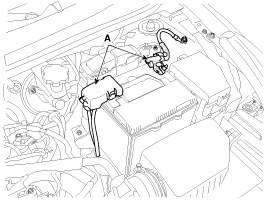
Disconnect the battery terminals (A). Disconnect
the negative terminal first.
|
| 2. |
Remove the air duct and air cleaner assembly. (Refer
to EM group)
|
| 3. |
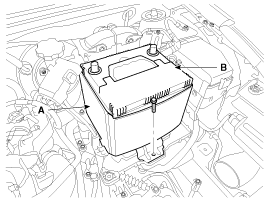
Remove the battery insulation pad (A).
|
| 4. |
Remove the battery (B) after removing the mounting
bracket.
|
| 5. |
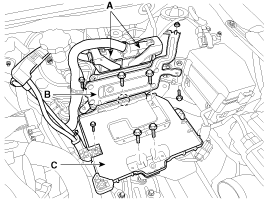
Disconnect the ECM connectors (A) and then remove
the ECM (B) and the battery tray (C).
|
| 6. |
Installation is the reverse order of removal.
|


 Inspection
Battery Diagnostic Flow
Vehicle parasitic current inspection
1.
Turn the all electric devices OFF, and then turn
the ignition switch OFF.
...
See also:
Removal
1.
Turn the ignition switch OFF and disconnect the battery
negative (-) cable.
2.
Lift the vehicle.
3.
D ...
Installation
•
Do not turn the ignition switch ON and do not contact
the battery cable while replacing the ...
Jump starting
Jump starting can be dangerous if done incorrectly. Therefore, to avoid harm
to yourself or damage to your vehicle or battery, follow the jump starting procedures.
If in doubt, we strongly recomme ...
Hyundai Accent Manuals

© 2011-2026 Copyright www.hamanual.com