 Hyundai Accent: Battery Sensor. Description and Operation
Description
Vehicles have many control units that use more electricity.
These units control their own system based on information from diverse sensors.
It is important to have a stable power supply as there diverse sensors giving
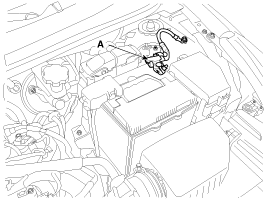
a variety of information. Battery sensor (A) is mounted on battery (-) terminal.
It transmits battery voltage, current, temperature information to ECM. ECM controls
generating voltage by duty cycle based on these signals.
|
When battery sensor signal fault occurs, inspect
the vehicle parasitic draw in advance after inspecting the sensor because
the sensor will behave abnormally when the parasitic draw is more than
100mA. (Refer to vehicle parasitic current inspection)
|
|
Perform the following process after replace the battery
sensor.
| -
|
Ignition switch ON/OFF.
|
| -
|
Park the vehicle about 4 hours.
|
| -
|
After 4 hours later, check the SOC (State
of charge) of battery using GDS.
|
|
|
For the vehicle equipped with a battery sensor, be
careful not to damage the battery sensor when the battery is replaced
or recharged.
| 1. |
When replacing the battery, it should be
same one (type, capacity and brand) that is originally installed
on your vehicle. If a battery of a different type is replaced,
the battery sensor may recognize the battery to be abnormal.
|
| 2. |
When installing the ground cable on the negative
post of battery, tighten the clamp with specified torque of
4.0~6.0N.m (0.4~0.6kgf.m, 3.0~4.4lb-ft). An excessive tightening
torque can damage the PCB internal circuit.
|
| 3. |
When recharging the battery, ground the negative
terminal of the booster battery to the vehicle body.
|
|
1.
Make sure the ignition switch and all accessories
are in the OFF position.
2.
Disconnect the battery cables (negative first).
...



 Cleaning
 Starting System