
 Hyundai Accent: Description of ESC
Optimum driving safety now has a name : ESC, the Electronic Stability
Control.
ESC recognizes critical driving conditions, such as panic reactions in
dangerous situations, and stabilizes the vehicle by wheel-individual braking
and engine control intervention.
ESC adds a further function known as Active Yaw Control (AYC) to the ABS,
TCS, EBD and ESC functions. Whereas the ABS/TCS function controls wheel slip
during braking and acceleration and, thus, mainly intervenes in the longitudinal
dynamics of the vehicle, active yaw control stabilizes the vehicle about its
vertical axis.
This is achieved by wheel individual brake intervention and adaptation
of the momentary engine torque with no need for any action to be taken by the
driver.
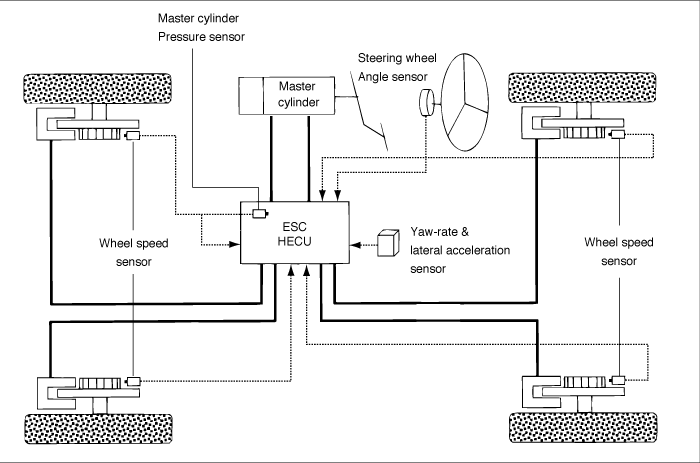
ESC essentially consists of three assemblies : the sensors, the electronic
control unit and the actuators.
The stability control feature works under all driving and operating conditions.
Under certain driving conditions, the ABS/TCS function can be activated simultaneously
with the ESC function in response to a command by the driver.
In the event of a failure of the stability control function, the basic
safety function, ABS, is still maintained.
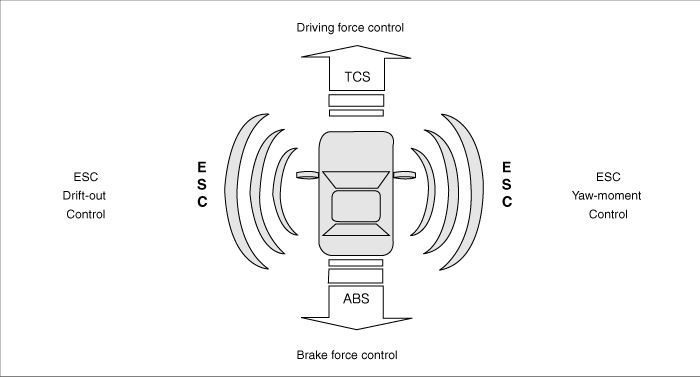
Description of ESC Control
ESC system includes ABS/EBD, TCS and AYC function.
ABS/EBD function : The ECU changes the active sensor signal (current shift)
coming from the four wheel sensors to the square wave. By using the input of
above signals, the ECU calculates the vehicle speed and the acceleration & deceleration
of the four wheels. And, the ECU judges whether the ABS/EBD should be actuated
or not.
TCS function prevents the wheel slip of drive direction by adding the
brake pressure and engine torque reduction via CAN communication. TCS function
uses the wheel speed sensor signal to determine the wheel slip as far as ABS
function.
AYC function prevents unstable maneuver of the vehicle. To determine the
vehicle maneuver, AYC function uses the maneuver sensor signals(Yaw Rate Sensor,
Lateral Acceleration Sensor, Steering Wheel Angle Sensor).
If vehicle maneuver is unstable (Over Steer or Under Steer), AYC function
applies the brake pressure on certain wheel, and send engine torque reduction
signal by CAN.
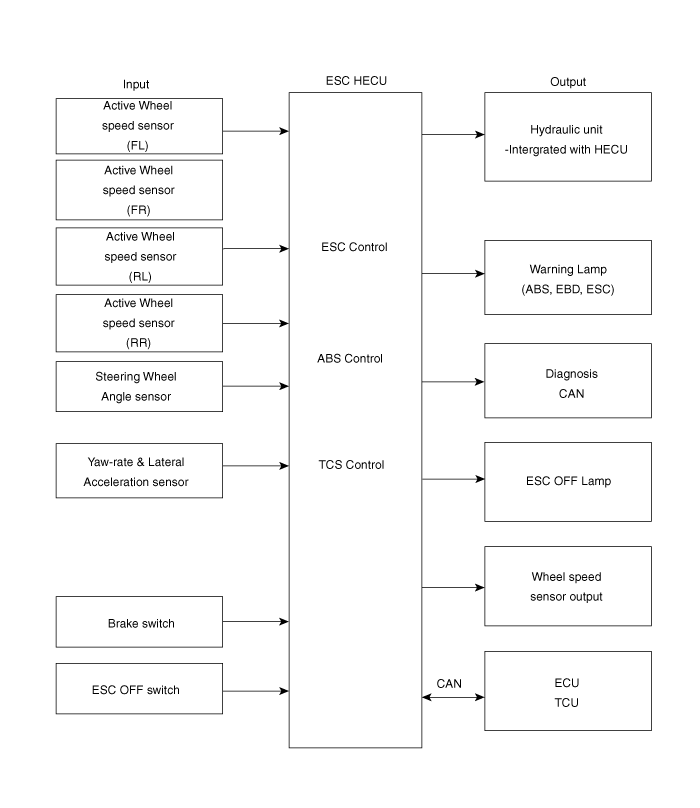
After the key-on, the ECU continually diagnoses the system failure. (self-diagnosis)If
the system failure is detected, the ECU informs driver of the system failure
through the BRAKE/ABS/ESC warning lamp. (fail-safe warning)
Input and Output Diagram

 ESC Operation Mode
ESC Hydraulic System Diagram
1.
ESC Non-operation : Normal braking.
Solenoid valve
Continuity
Valv ...
See also:
Overdrive Clutch Control Solenoid Valve(OD/C_VFS). Schematic Diagrams
Circuit Diagram
...
Removal
1.
Remove the under covers (A).
Tightening torque:
6.9 ~ 10.8N.m (0.7 ~ 1.1kgf.m, 5.1 ~ 7.9lb-ft)
...
Inspection
Check for continuity between the terminals while operating the wiper and
washer switch. If it is not normal condition, replace wiper and wiper switch.
Wiper Switch
Washer Switch ...
Hyundai Accent Manuals

В© 2011-2026 Copyright www.hamanual.com