
 Hyundai Accent: Removal
| 1. |
Turn ignition switch OFF.
|
| 2. |
Remove the battery and battery tray.
(Refer to Engine Electrical group - "Battery")
|
| 3. |
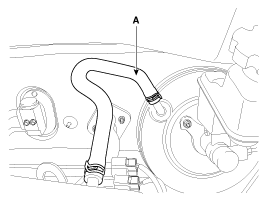
Disconnect the vacuum hose (A) from the brake booster.
|
| 4. |
Remove the master cylinder.
(Refer to Master cylinder.)
|
| 5. |
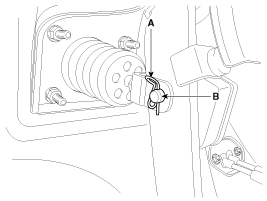
Remove the snap pin (A) and clevis pin (B).
|
| 6. |
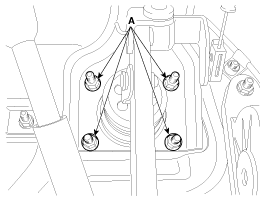
Remove the brake booster mounting nuts (A).
|
| 7. |
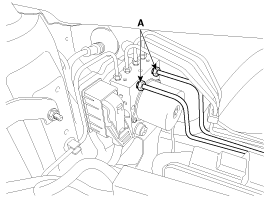
Disconnect the brake tubes (A) from the HECU by unlocking the
nuts counterclockwise with a spanner.
|
| 8. |
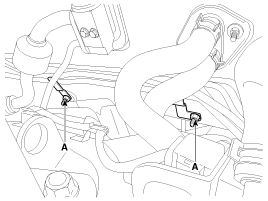
Remove the brake tubes mounting nuts (A).
|
| 9. |
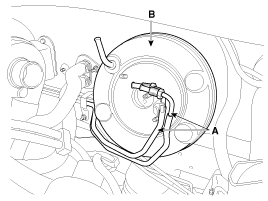
Pivot the brake tubes (A) down out of the way.
|
| 10. |
Remove the brake booster (B).
|
 Brake Booster Operating Test
For simple checking of the brake booster operation, carry out the following
tests.
1.
Run the engine for one or two minutes, and then stop it. If the
pedal depresses ...
 Inspection
1.
Inspect the check valve in the vacuum hose.
Do not remove the check valve f ...
See also:
Rail Pressure Sensor (RPS). Troubleshooting
Signal Waveform
...
Accelerator Position Sensor
(APS). Schematic Diagrams
Circuit Diagram
(M/T)
(A/T)
...
Specifications
Items
Specifications
Clutch operation method
Hydraulic type
Clutch cover
Type
Diaphragm spring strap ...
Hyundai Accent Manuals

В© 2011-2026 Copyright www.hamanual.com